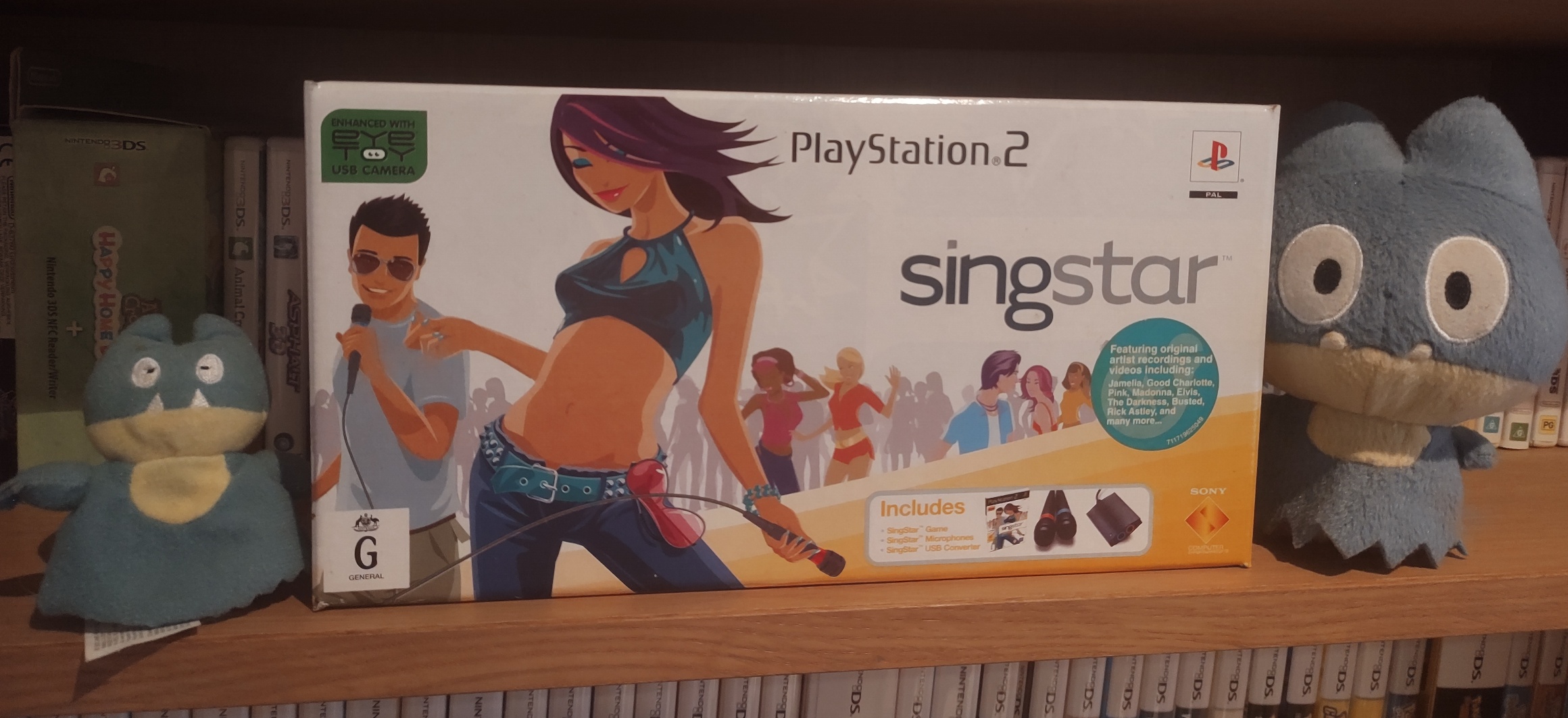
 Here’s a photo of my real SingStar box from way back in the day.
A brief history on karaoke
SingStar was Sony’s foray into the karaoke genre of video games; a genre which simply involves singing into a microphone and being graded on your accuracy to match the notes put in front of you. The genre dates way back before video games achieved mainstream, but other than some curious releases such as Bandai’s Karaoke Studio for the Famicom, the rhythm game genre in general found a wave of success once Konami’s Dance Dance Revolution hit the scene in 1998, and particularly 2003’s Karaoke Revolution (developed by Harmonix and also published by Konami) brought forth a fully realised karaoke experience. SingStar most likely was pitched and developed in response to this, with the earliest working press prototype showing up in February 2004, and a full game release by May of 2004, with many more iterative sequels and releases already planned out. SingStar’s claim to fame was its ability to license original recoridngs of popular music accompanied by their music videos (compared to Karaoke Revolution’s MIDI renditions). While there were plenty of Karaoke Revolution titles released up until 2011, we quickly saw other competitors, such as Harmonix’s own Rock Band in 2007, Neversoft’s Guitar Hero titles from 2008 onwards, Microsoft’s Lips, Ubisoft’s U-Sing, and EA’s Boogie.
SingStar itself continued to release new titles throughout the next 10 years, moving into the PlayStation 3 with most songs being released as downloadable content rather than exclusively through retail discs, and eventually onto the PlayStation 4 with a free to play model utilising smartphones as the microphones rather than bundling in the USB peripheral. There were even bizarre spin-offs to compete against Guitar Hero and Just Dance, but ultimately it seemed interest in rhythm games across the board started to wane by 2010, with new releases slowing down from 2014 until the online services were shut off in 2020. The studio behind all these titles, London Studio, eventually was closed by Sony in 2024.
As you may’ve guessed, London Studio was based in London and the majority of SingStar’s initial market was conceived exclusively for European countries. The first SingStar release in the USA was not until November 2006 with a release of SingStar Rocks (which for note had released in Europe in April). America would receive eleven PS2 releases of SingStar in total until 2009, but because of this late arrival to the franchise, the PlayStation 3 releasing at about this time (which for note didn’t release until four months later in Europe), and the competition from other rhythm game franchises, it doesn’t seem as if SingStar had quite the same market across the Atlantic.
I’m an Australian, and in the year of 2004 and especially 2005, SingStar was a massive franchise down under. I knew of a lot of households who already owned a PlayStation 2 and complemented their existing game setup with this fairly affordable karaoke title. New titles were released quite frequently at $50 AUD, and often you’d find a lot of them for half price shortly afterwards. You’d read the tracklist on the back of the box and determine whether it’s something you’re interested in, and you’d keep building your library. The game had the ability to switch discs with any other SingStar title without switching off the system (or leaving your multiplayer party mode) which made it a pretty fun experience to keep expanding the song count.
Introducing regional songs
One thing I did notice though was a big sticker on the Australian release of SingStar Rocks labelled: Now featuring Australian rock hits!. Australians love their local (or at least national) music, and having Australian artists such as Jet and The Veronicas show up in a video game felt like a massive deal to us. We’d also have various Australian songs show up in other titles later down the line, but I think this one point in time was the most significant move for the Australian market that made the franchise feel special and targeted.
But what I wasn’t aware of was that almost every release of SingStar in every region followed this approach; sprinkle some local songs here and there in each release and market it heavily to the music interests they have at the time. Almost every release of SingStar, even if they share the same name as other releases, has a slightly different track listing as another release. On top of that, there’s many releases that never appeared in Australia at all. Obviously with the internet one can look up many of these titles and see ones like SingStar Fussballhits or SingStar Norsk på Norsk show up, but beyond a somewhat incomplete Wikipedia page, there’s actually not a great resource on which games include which songs.
Back in February 2024, I developed a RetroAchievements set for the original SingStar. I was then informed that even though I covered the 30 songs on-disc in this title, the other releases of the game all had some unique songs on them. In September 2024, I went back and investigated the four non-English releases of the game, finding 37 songs across them that were not featured in the English release of the game. Curiously, in the German release was The Lightning Seeds’ Three Lions and Jamiroquai’s Deeper Underground, two songs that are definitely not in German or by German artists. I also continued to do a SingStar Party RA set in June 2025 with the regional exclusives handled at the same time, finding songs like David Lee Roth’s Just a Gigalo / I Ain’t Got Nobody and Bananarama’s Venus in the German release again.
For both of these games, it was easy to classify which songs I’d handle in the core achievement set, and which ones were in the regional exclusives subsets; the entire English release felt appropriate as the core set, and any song that was only in the non-English releases would be in the subset. Conveniently, if a song appeared on a non-English release, it’d only appear in one of those releases, making the logic for the achievement set straightforward. But that got me wondering, was that true for the rest of the franchise?
Just to add to matters, there is no USA release of SingStar or SingStar Party, making it easy to consider the European release as the primary release for the game for RetroAchievements. But SingStar Pop is indeed the name of a USA release, and by convention a RetroAchievements set often uses the USA release as the primary hash to target for an achievement set, so would there be any weird issues with that compared to the European releases?
Investigating 170 discs of SingStar
I set it upon myself to catalogue every song that appears in the Sing Solo menu of every single one of these SingStar titles. I used redump.org’s catalogue of every release to verify that I had found them all, and after 170 discs (for reference, I could not find two releases; a demo disc of SingStar Rocks, and a v2.00 disc of SingStar Mallorca Party, neither are probably hiding any secret tracks) I believe I’ve catalogued all 2,507 total songs that appear on every release of SingStar on the PlayStation 2. I’ve described each disc in a repository as a YAML format, and using pyvis I was able to visualise all the releases and see which editions shared songs with each other.
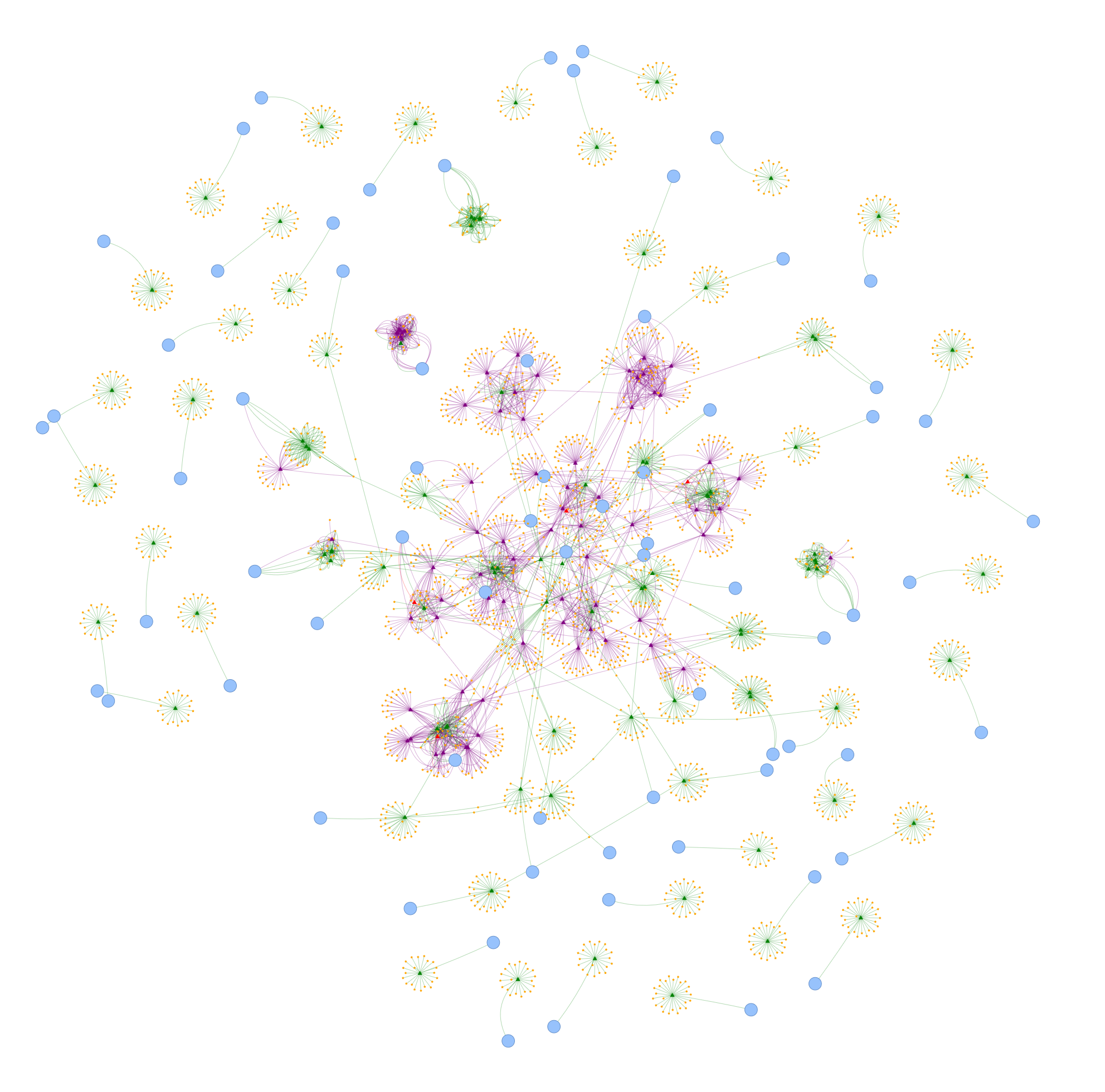 There’s a lot of releases to look at, but at the surface you can easily see there’s a lot of titles in the middle that have lots of overlapping elements next to each other, while there’s plenty of dangling releases that don’t connect to any other ones. Lets break it down.
The first thing I noticed was my hunch about USA releases are correct. Many USA releases lagged behind the PAL releases, and due to the difference in geographic region, none of the discs are compatible with each other. Some songs were newer and more relevant for the release of the title, and some songs were pulled from other earlier PAL releases, but they muddy up the whole chart. Let’s start by removing them for the moment. Let’s also remove demos just because they clutter the graph a bit.
 Now this graph is a bit easier to look at. There’s only a few dozen songs that seem to cross between releases, making most of the primary release blue circles connect to fairly distinct clusters of releases and songs. Let’s dig a bit deeper into this.
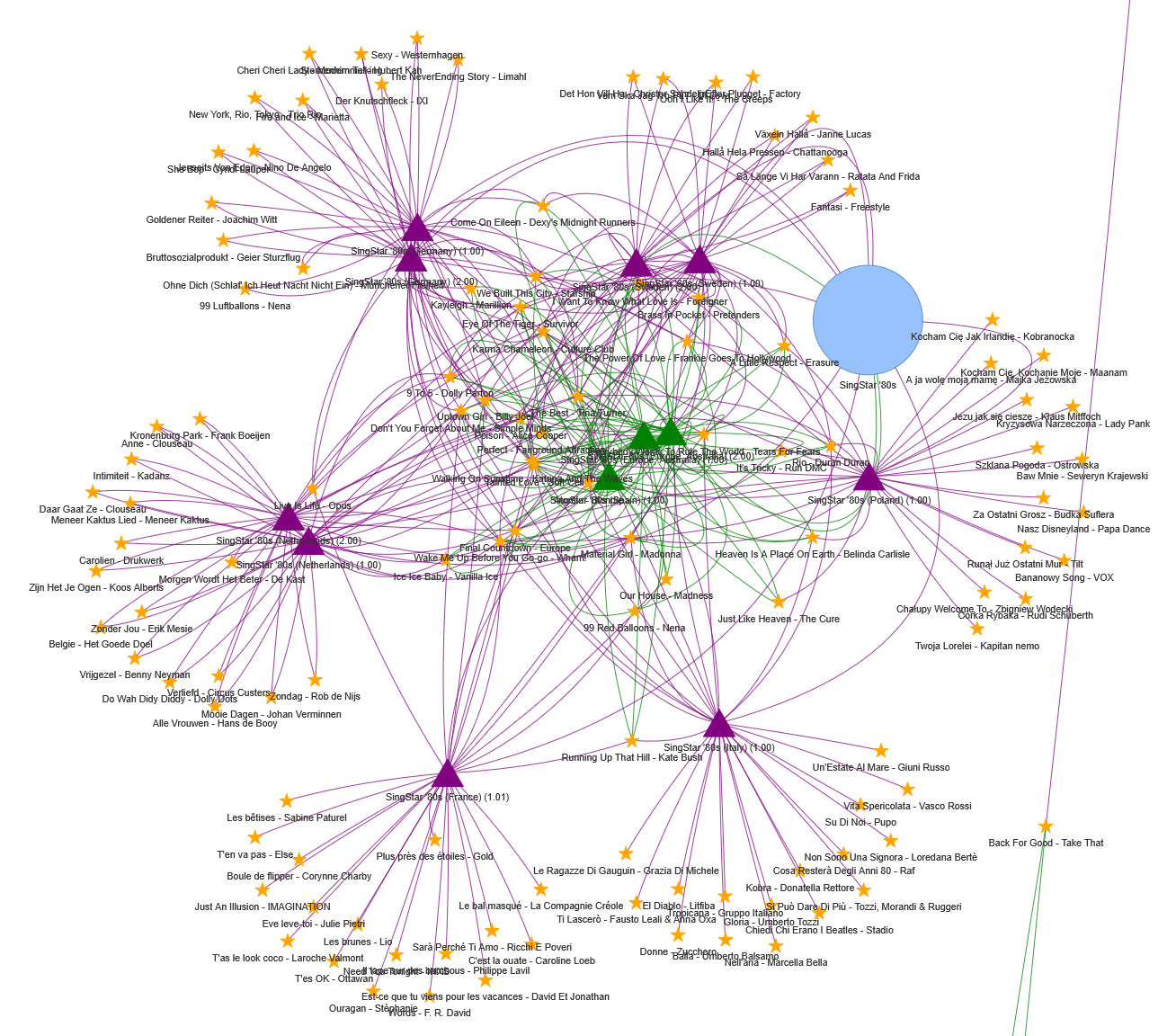 Looking closer at SingStar ’80s, we can see that no song that appears in the 12 releases of this game appear in any other named release (if we ignore the USA release). I’ve coloured what I’ve called “primary releases” as green triangles, and all of them all share the same songs as each other. In this case, we’ve got a v1.00 and v2.00 European and Australian release of the game, along with the Spanish release all sharing the same songs. Songs like Kate Bush’s Running Up That Hill can be seen as linking to those releases, along with the French and Italian release, but not in the other releases.
As I went through each game, I also decided that games that had entirely different track listings, even if they released at exactly the same time as other releases, would classify as their own primary releases. For example, France’s SingStar Pop Hits 3 and SingStar Italian Greatest Hits both have serial numbers that sit right between all the SingStar Summer Party releases, but since they share no songs between them, I decided to count them as their own releases.
There’s very few songs that appear in multiple games at this rate though, but you can still see a few long lines that span across the graph. Naturally we’ll see some songs such as Queen’s Don’t Stop Me Now appearing in both SingStar Rocks and the much later SingStar Queen, as well as regional ones like Kent’s Columbus appearing in both SingStar Svenska Stjärnor and SingStar Kent (both Swedish only releases) since they’re artist-specific releases that probably would be improved by having one of their more popular songs. You’ll also see Franz Ferdinand’s Take Me Out appear in Germany’s release of SingStar Amped, but no other releases of that title, potentially because it appeared in the English, French, and Italian releases of SingStar Party. But on the other side, Ashford & Simpson’s Solid appears both on the English and German release of SingStar Party, as well as Germany’s SingStar Chartbreaker. Germany’s exclusive titles SingStar Fussballhits and SingStar Mallorca Party both share Almklausi’s LoLoLos Geht’s and DJ Ötzi’s Hey Baby.
But for the most part, these overlapping titles are quite rare, making it easy to divide up the games by their apparent primary releases. However, there’s two curious releases in this mix which I’ve also excluded from these past few graphs: the aforementioned SingStar Italian Greatest Hits, and Germany’s SingStar Die größten Solokünstler, both of which contain no songs new to their own titles but instead are a variety pick of songs from other titles. In the case of SingStar Italian Greatest Hits, they’re all Italian songs that appeared on Italian releases in other games. SingStar Die größten Solokünstler is sort-of like a catch-up release for various other songs across the franchise, some of which definitely got German releases already. They don’t line up with any other release, but they’re curious ones to call out.
I’d also like to call out that there’s a few titles later in the franchise that got PS3 releases such as SingStar The Wiggles and SingStar Queen, but curiously there’s a group of non-English releases that all start with a PS3-era FMV featuring Pink’s So What despite them not including the song on disc. In particular, Spain’s SingStar Pop 2009 actually matches a lot of the PS3’s SingStar Pop Edition track listing, but not perfectly (e.g. it’s got Amy Winehouse’s Rehab and The Killers’ Human, but lacks songs like Queen’s Bohemian Rhapsody and has songs like Rosario’s No Dudaría instead). There’s a lot of releases all over the place that have curious collections of songs that aren’t really documented anywhere.
One interesting release is SingStar Singalong with Disney, which released in England, Australia, Spain, France, Germany, Portugal, Italy, Sweden, Denmark, and the Netherlands. It includes 20 songs from various Disney movies, but interestingly most of the songs are localised for their appropriate countries (e.g. if you play the Portguese version, You’ve Got A Friend In Me becomes Sou Teu Amigo, Sim). There’s a couple of songs that still remain in English across all of these releases, but it’s nice to see the effort to handle all of these languages. Curiously as well, there’s two German releases that are identical other than one has all the songs still in English, while the other they’re in German. For the purposes of this analysis though, I’ve considered every country’s releases as the same songs even though they are enumerated with different names.
There’s also a German demo disc released in 2009 containing five songs from various earlier SingStar titles, which I’ve named the SingStar 2009 Demo. It’s just a curious release because no individual title contains the five songs it features.
There’s not much to say once you re-include the USA releases, but there’s two interesting titles of note to bring up. Firstly, SingStar Latino, which only got a Spanish and Portuguese release in Europe, does indeed have a USA release with several songs that had appeared on many other older Spanish releases of SingStar. Secondly, SingStar Country is surprisingly an entirely original release with 30 songs that do not appear on any other SingStar release. Including those 30, there’s 115 total songs that appear on America’s PS2 releases of SingStar such as The White Stripe’s Blue Orchid and A Flock Of Seagulls’ I Ran (So Far Away).
Statistics about it all
As a final note, let’s do some charts of things I found along the way.
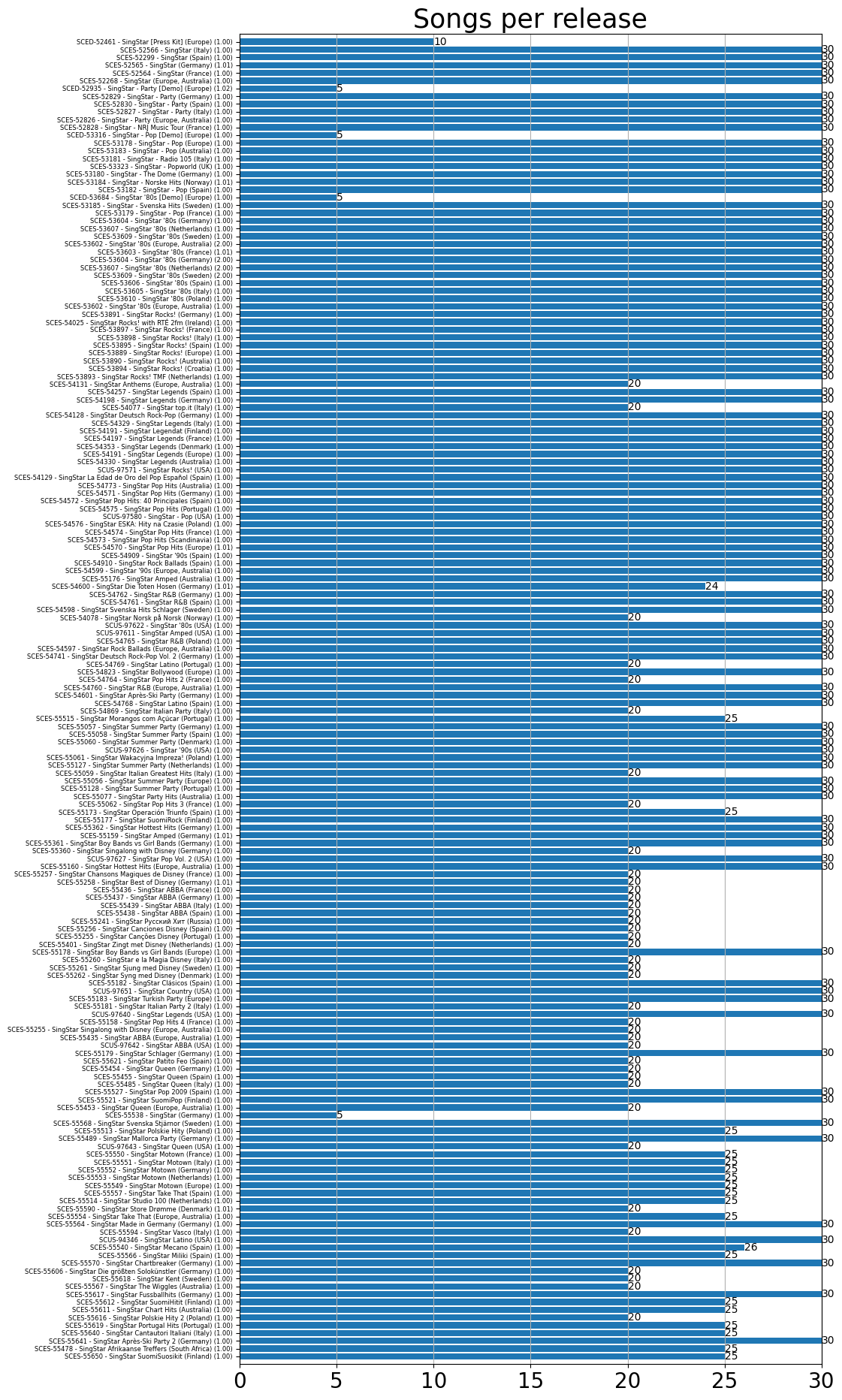 Firstly, counting how many songs are in each release of SingStar, you can see that while most of the earlier ones included 30 songs, many later releases started to drop down to 20 which makes them tougher on the value front.
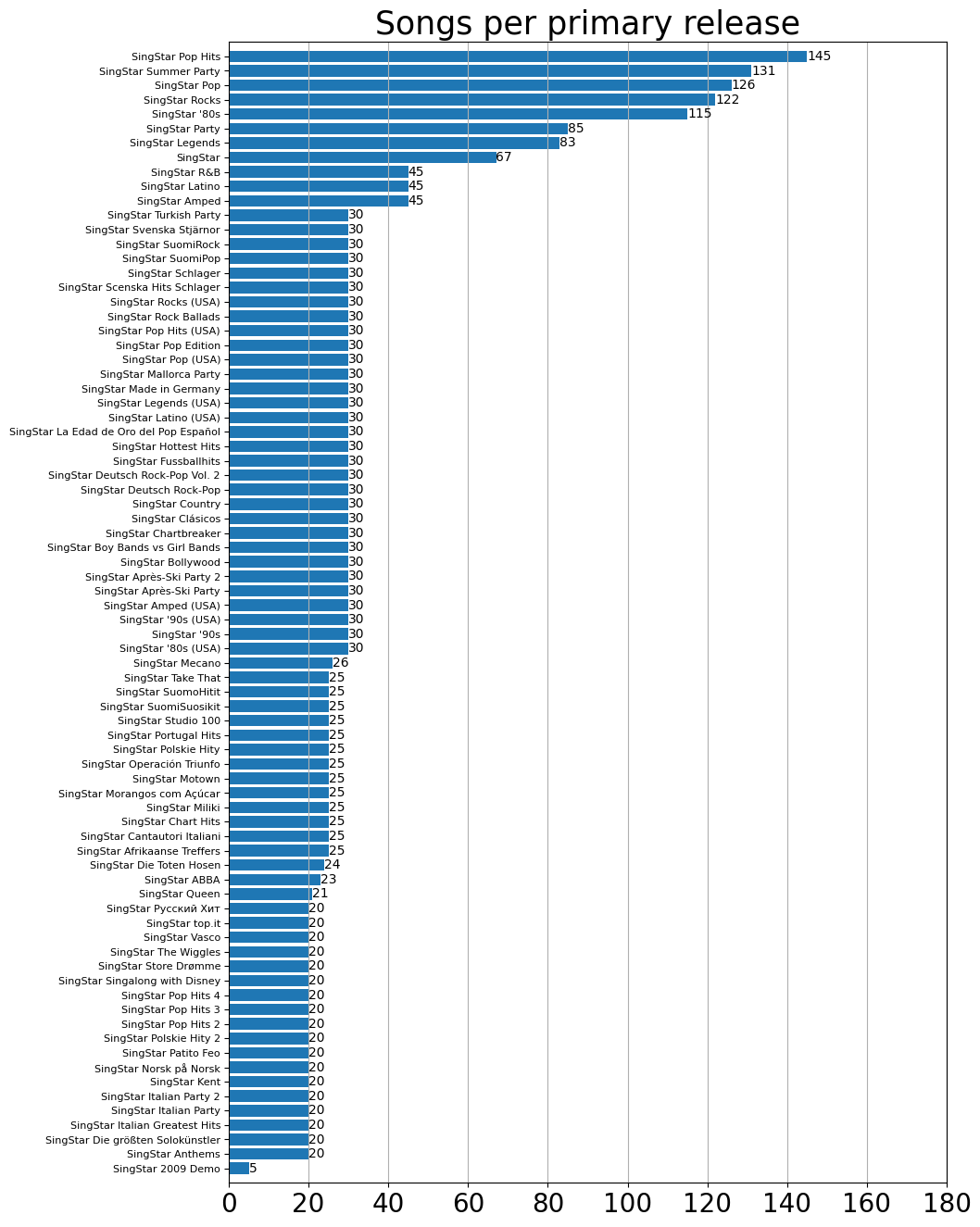 When thinking of the RetroAchievements sets and handling the regional exclusive subsets, I thought it’d also be good to count how many songs were within a primary release. It’s interesting to see SingStar Pop Hits top the list at 145 total songs, and a bit daunting given I’ve only currently covered SingStar’s 67 and SingStar Party’s 85 songs. The next title, SingStar Pop, is also third on the list with 126 total songs.
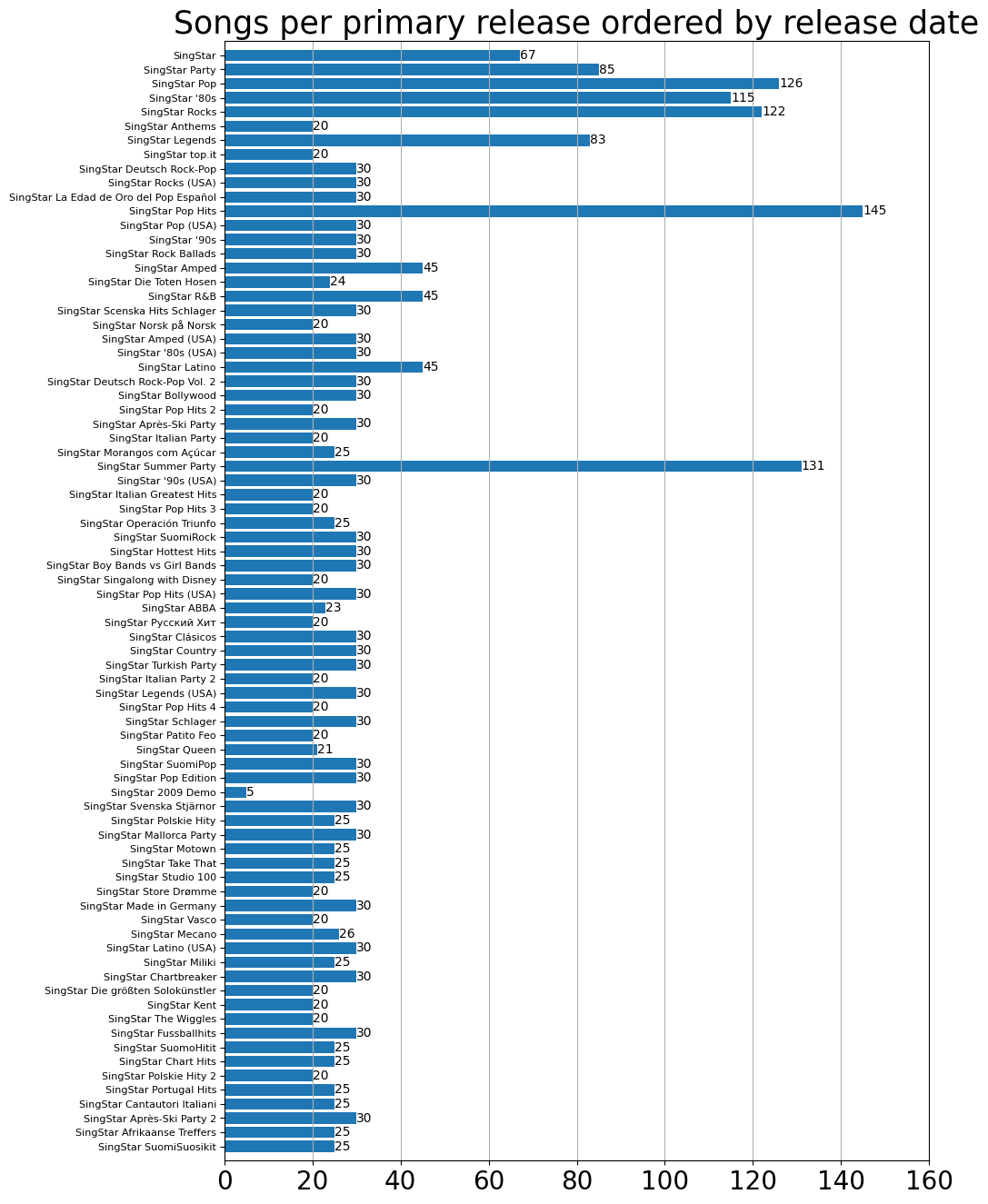 Taking the same graph and just ordering everything by release date (or EXE sign date if a release date isn’t known, which isn’t quite accurate), you can spot that the original five releases were all multi-regional releases with lots of unique songs between them, but afterwards there’s only a few other titles that were released like that. Curiously a few of the titles later on with 45 total songs had only English, Australian, and German releases. And if you’re wondering, I’ve grouped these into 77 primary releases (with most USA releases counting as their own primary release other than SingStar ABBA and SingStar Queen).
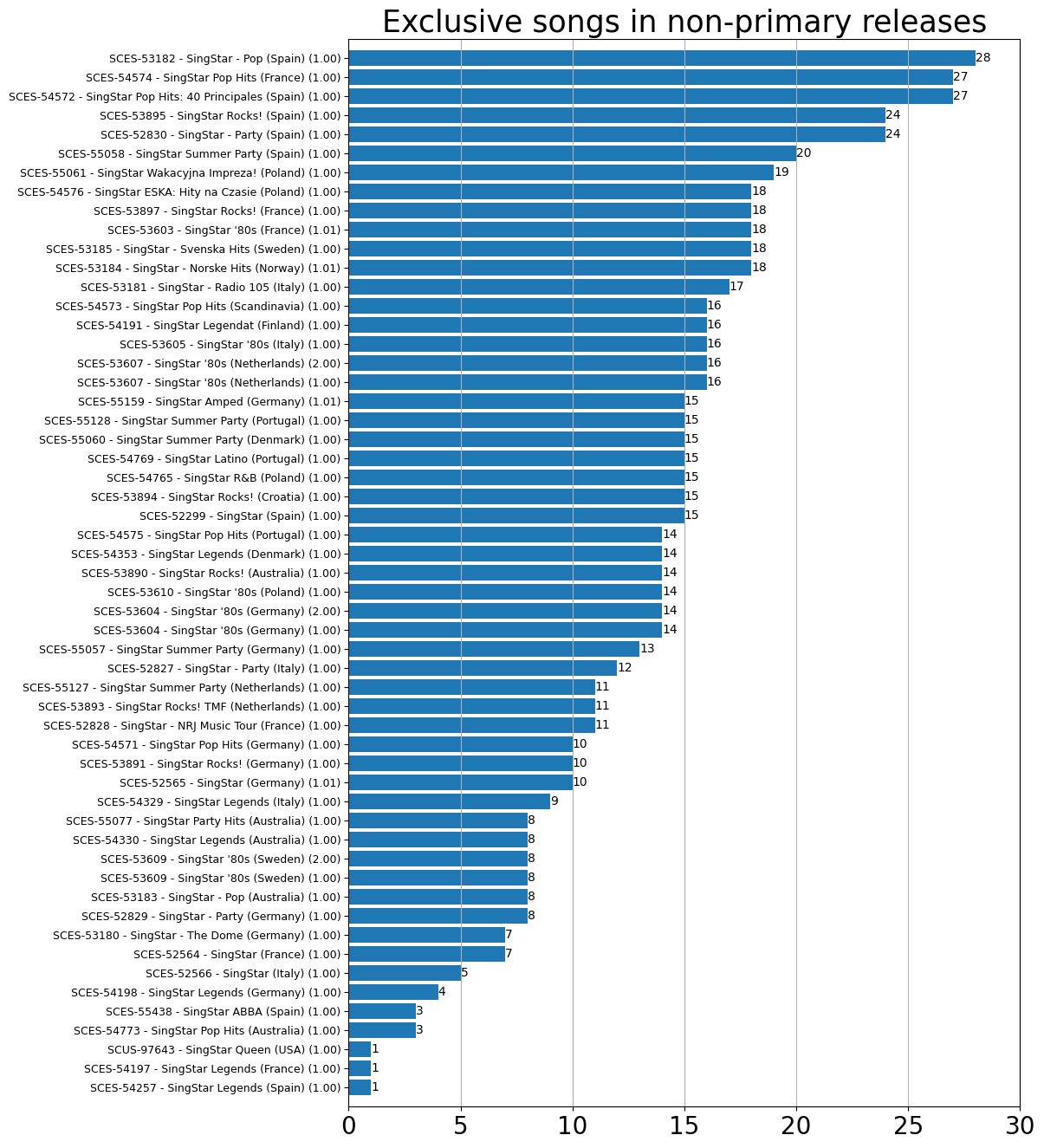 We can see a wide range of how many exclusive songs are in each regional variant of SingStar, some having just 1 and the most having 28 of its 30 songs exclusive to it! Most of the top ones are Spanish releases as well which is quite interesting. You can also spot SingStar Rocks (Australia) in the middle there at 14, whereas other Australian releases have much fewer exclusive songs, so my earlier sentiment about Australian representation was fairly short lived.
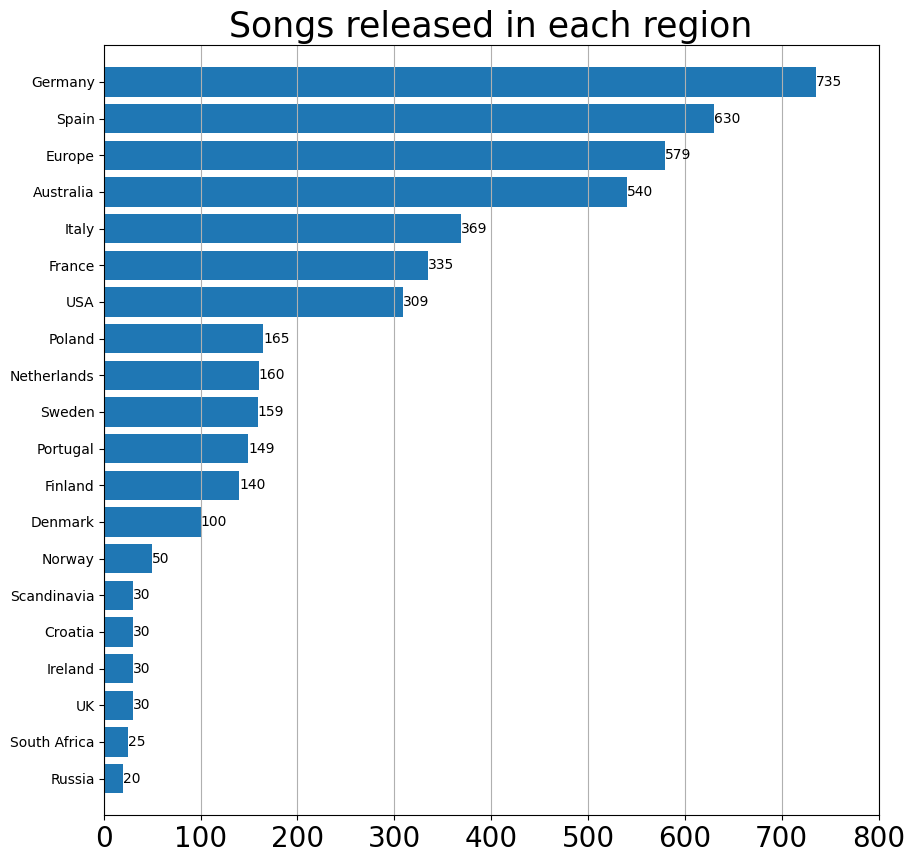 Counting how many songs were released in each country (just for note, Europe in Redump’s terms often means England in this case, but I can imagine an English release appearing in other non-English speaking countries). It’s interesting to see Germany and Spain topping the table above Europe and Australia. Seeing USA at 309 songs is also quite interesting as it reflects my thoughts on how few titles ended up in that country, and especially since you can’t put in any other country’s games to expand the library even more.
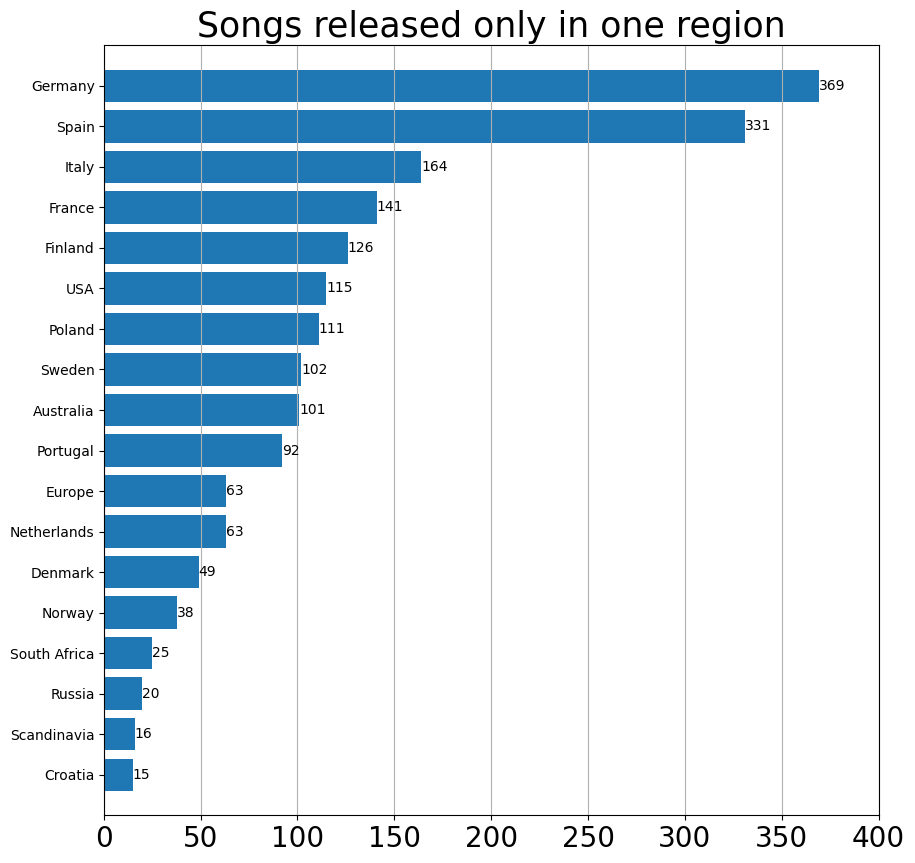 To go one step further, it’s interesting to see a lot of Spanish and German songs only appear in Spain and Germany. There’s a bit of overlap with other countries (e.g. SingStar Latino sharing with Portugal and the USA, and various Europe releases overlapping with Australia), but it’s surprising to see a lot of Finnish songs later in the release cycle show up here.
 As a curiosity, there’s a lot of artists who appear multiple times in the franchise. In various regional releases, this can even be 3 or more songs in the same game! Naturally we’ll get the artists with band-exclusive games at the top, but it’s interesting to see many bands appear so many times in the franchise.
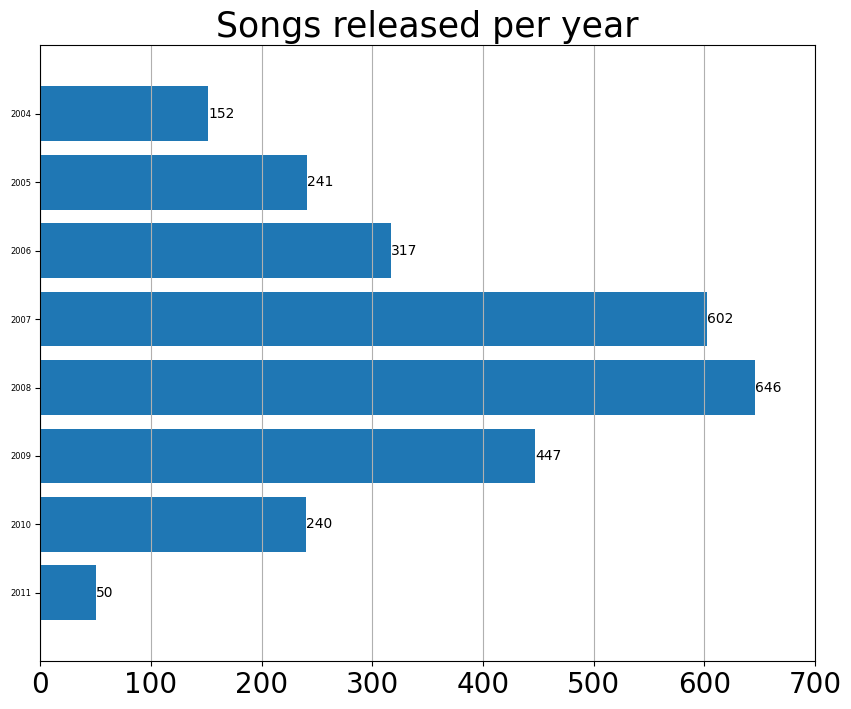 Finally, here’s how many songs were released in each year’s releases of SingStar. You can see it peaked in 2008, most likely because of the release of the PS3 versions by that point driving attention away, but it’s interesting to see releases even up to 2011. I’m not aware of many of the songs in the 2011 releases (as they’re not in English), but 2010’s SingStar Chart Hits is a curious collection of titles from a time when Guitar Hero was about to retire as a franchise (and yet we’re still getting first-party PS2 titles).
The takehome
In total, there’s 2,507 songs I found across 170 different discs of SingStar in just the PS2 releases. There’s obviously more songs supported in the future PS3 releases, but even though it was natural for new releases to move to digital only track packs, with the server closure in 2024, it’s apparently impossible to re-download these songs making it an eventual form of lost media. These PS2 releases have at least been preserved and shared across the internet in a way that anyone can relive the karaoke experience of any of these time periods or even geographic locations through these titles. Going through each title was a bit of a chore but I think it was great fun to document and categorise what titles had what kinds of songs.
In terms of gameplay, almost all the games are the same. There’s a duet feature added from SingStar Party onwards, rap verses in SingStar Pop, and a new interface from SingStar Boy Bands vs. Girl Bands, as well as some party features introduced in some of the titles, but for the most part you’re getting the same game with a reskinned menu and a different song list. There’s also a career mode in the very first SingStar that never re-appeared in any other title, as well as a two-player Pong game exclusively in SingStar ’80s (not the USA release as well), but otherwise I can’t find any weird exclusive modes or features in any of these games.
I mainly wanted to forward spec out the RetroAchievements sets and see if there were any weird titles moving forward, but I’m fairly confident in my gut feeling on handling the USA releases separately in most cases is the ideal path to covering each SingStar game. And as for people playing the games, I’ve put everything in a GitHub repository as well so you can check it out and correct any mistakes. Hopefully going forward people can find some use out of determining which songs appeared in which games (maybe that’s a general tool that’d be nice as well across all media, I do like knowing when a song or movie appears in some other piece of media). Thanks for reading, and happy singing!